
What swans are for
And have you changed your life?

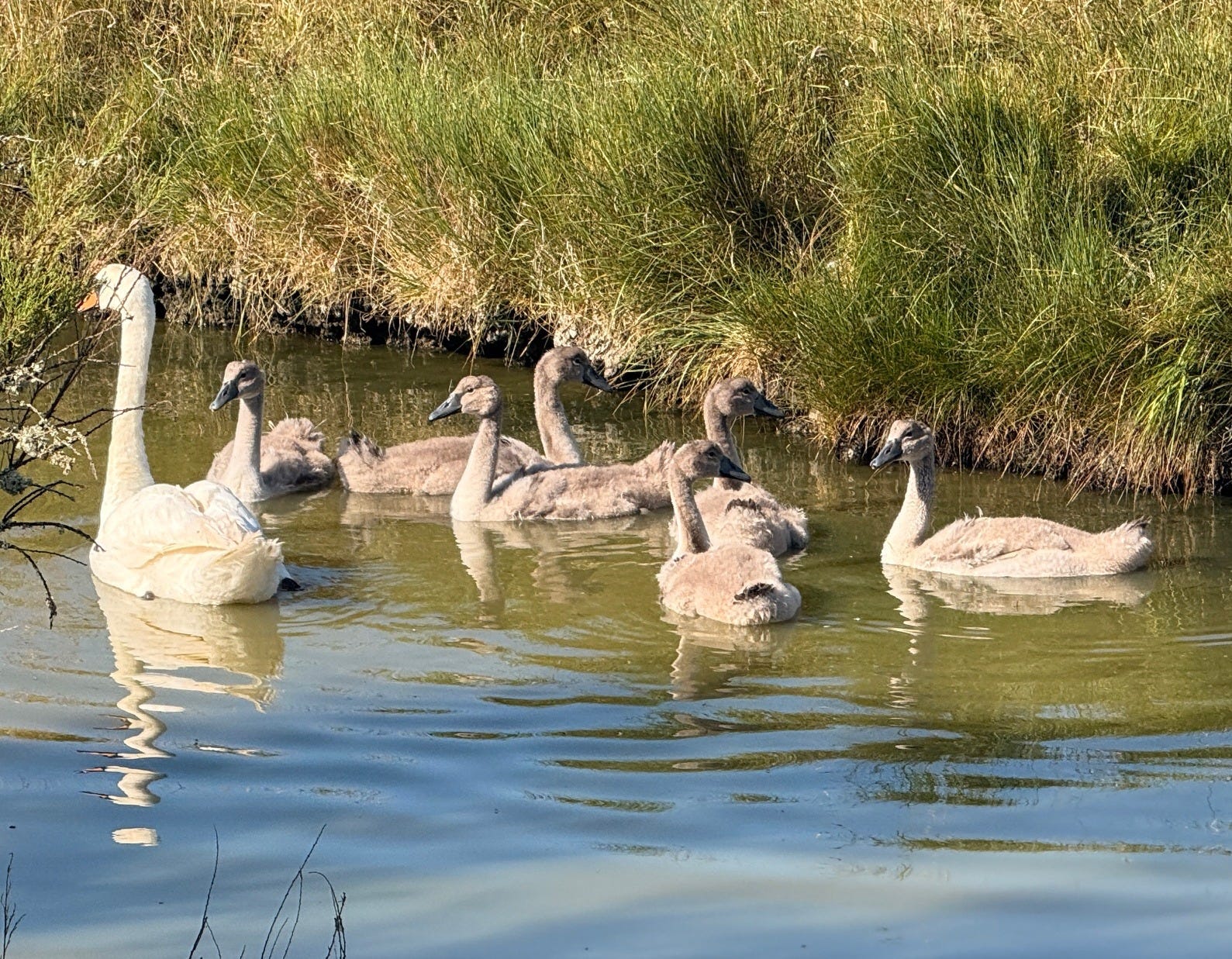
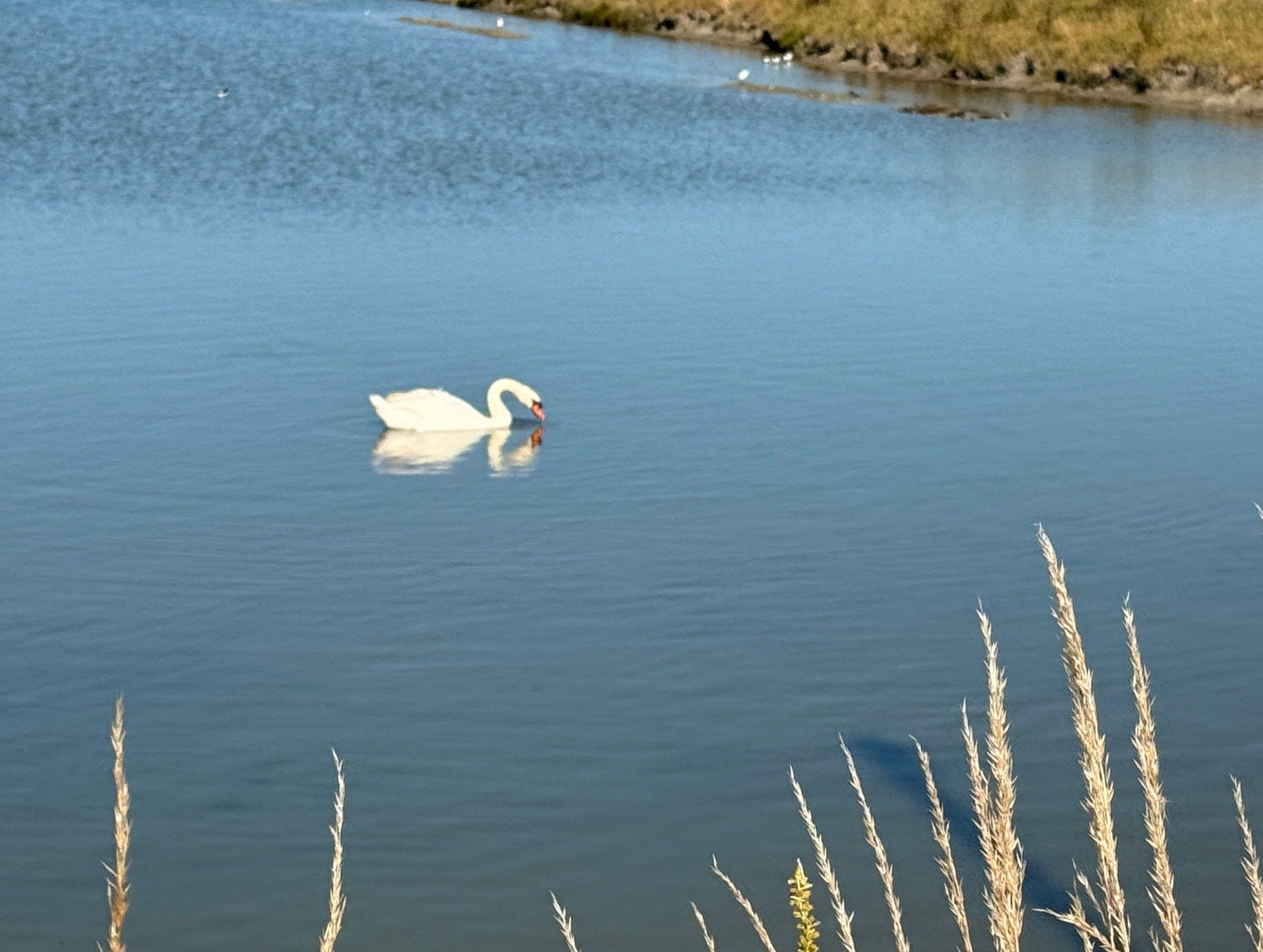
I have a lot of photos of swans. I was always thrilled to see them. My first swan family was near Beauvoir-sur-Mer, along the canals south of Nantes. It was one of the days of the French heatwave, in a dusty and treeless area where the sun burned, the map was striped with canals, and signs advertised oysters and mussels. I paused my sweaty toil to watch them glide along and snap some pictures. Later that night, I posted the photo below.
Weeks later, on a walking tour in Bruges, we heard the story of the 101 swans. The very unpopular Archduke Maximilian of Austria, who would become the Holy Roman Emperor, controlled the lands now known as Belgium and brutally imposed high taxes to fund his numerous wars. The people of Bruges revolted, captured Maximilian and beheaded his advisor (and ruthless tax collector) Pieter Lanchals. Maximilian escaped and demanded that Bruges honor his advisor by forever keeping at least 101 swans on the canals of Bruges—because the name “Lanchals” is Flemish for “long neck.”
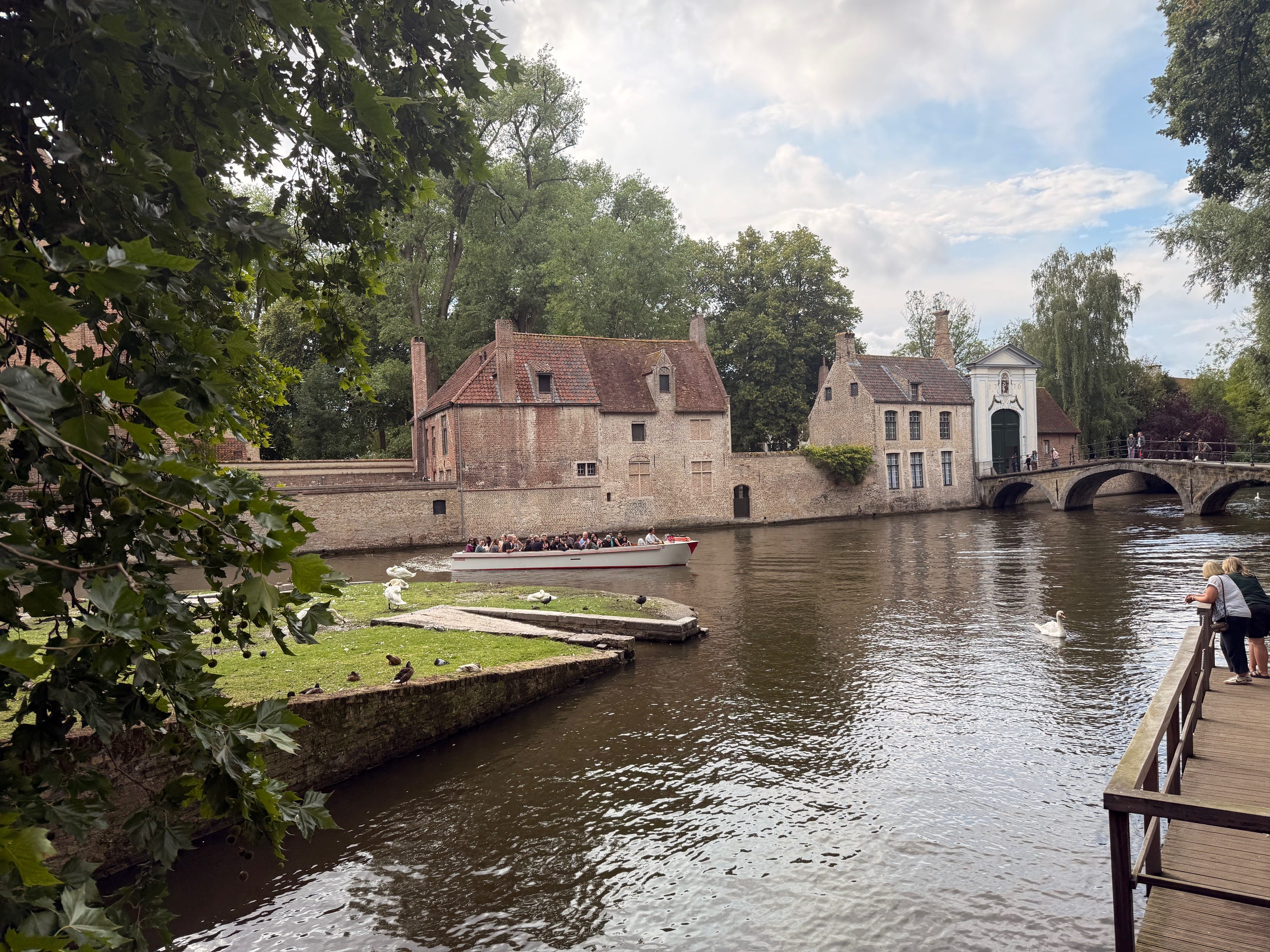
This may or may not be true, but they love the story in Bruges and take loving care to ensure a population of more than 101 swans at all times. In the canals, in particular in front of the Beguinage (photo above) swans happily congregate, gliding, pruning, and scattering their white feathers while tourists snap photos. They’re so valued that in 2021 they were collected and held in quarantine for five months to protect them from bird flu.
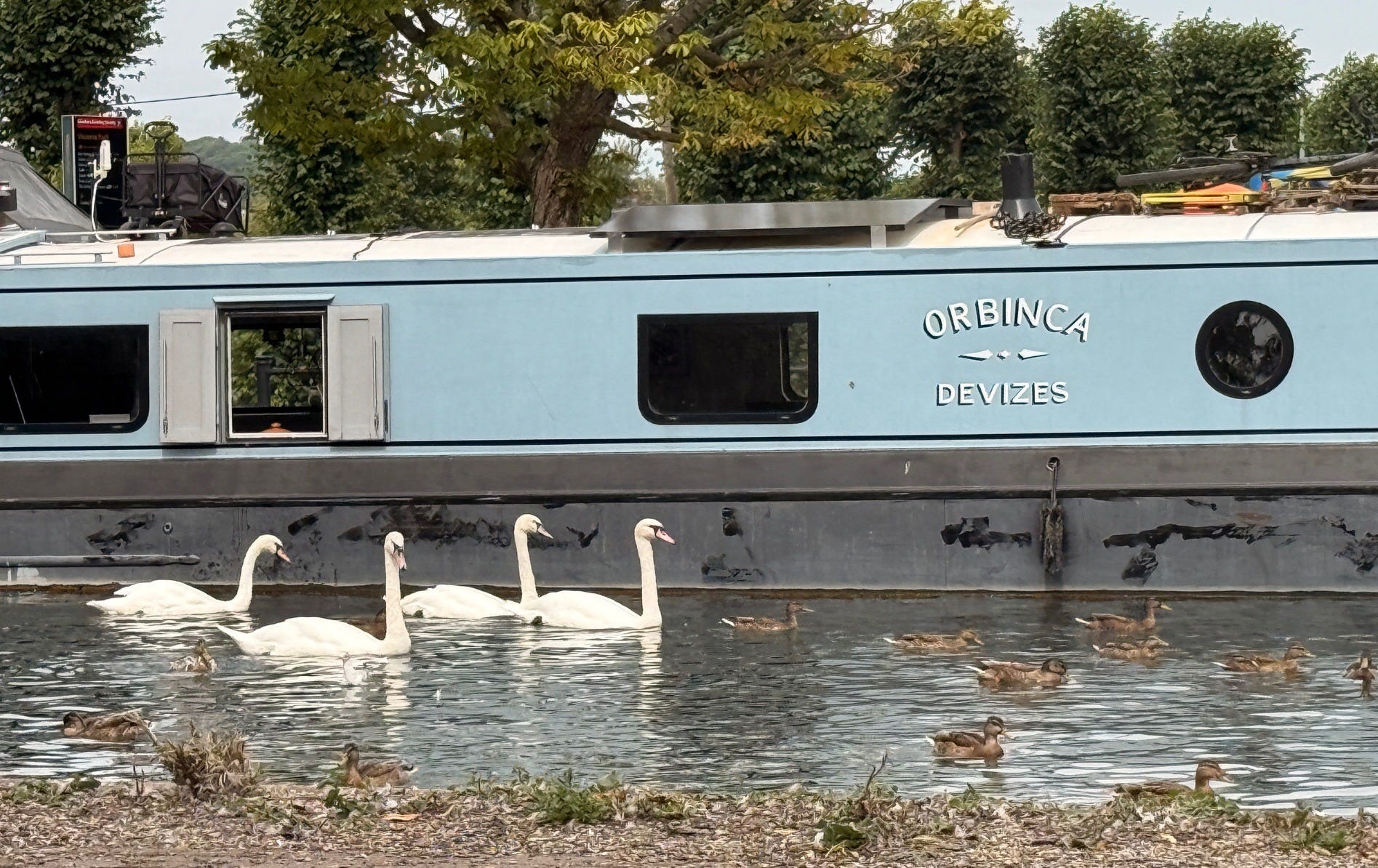
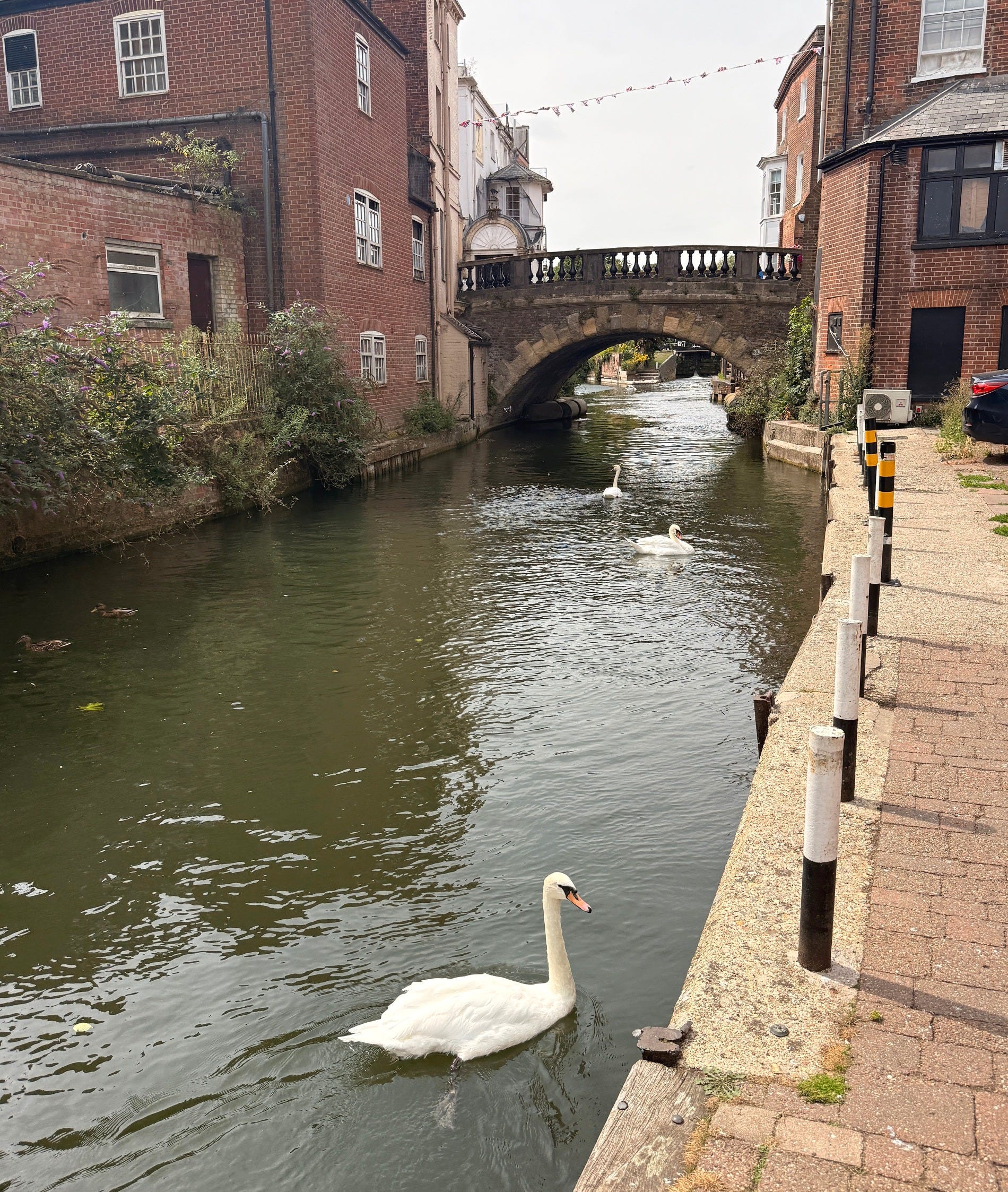
But swans really put on a show in England, where they traversed the canals I followed from London to Wales, including the tow path along the Avon Kennet canal. They drifted in between the long boats and the grassy banks, going bottoms-up seeking pondweed and waterweed. The cygnets were usually adolescent-looking, nearly as large as their parents but still covered with gray-brown downy plumage. The mama led the young ones while dad hung back at the rear, clearly ready to strike if anyone threatened.
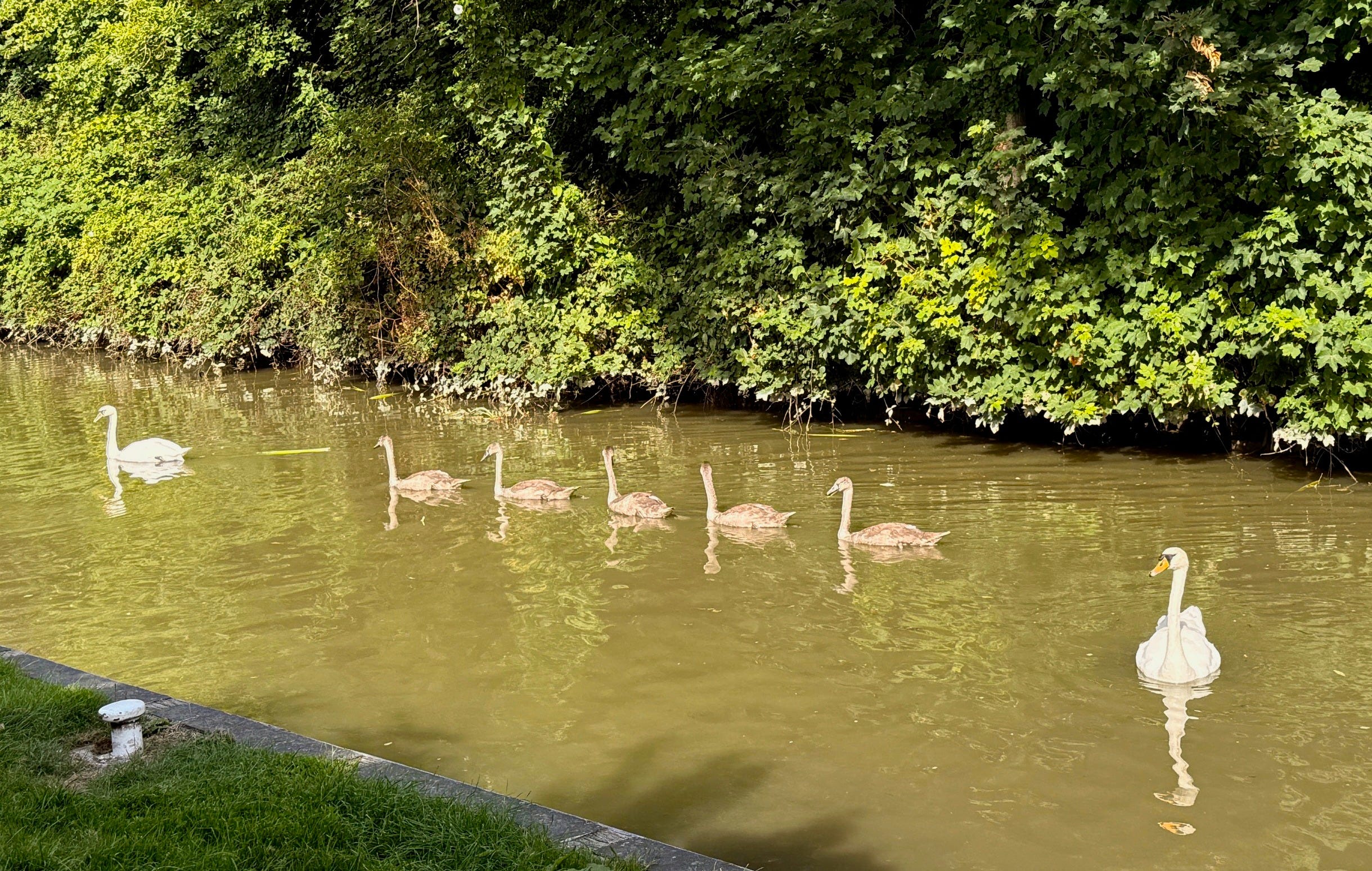
These are Mute Swans (Cygnus olor), with distinctive orange beaks, unlike their migratory cousins the Whooper Swan and the Bewick's Swan. The Mute Swan is native to much of Eurasia and the far north of Africa and is not really mute—just quieter than their noisy cousins.
Mute swans were roasted and eaten by royalty for hundreds of years, but because they were never successfully domesticated, the elegant birds roamed free. In the 12th century, all swans were considered the property of the monarch. By the 15th century, some individuals were allowed to own swans and marked them with proof of ownership on their beaks. Those without marks were considered the property of the monarch, and technically, present-day King Charles owns all unclaimed swans, which at this point is nearly all of them.
Yes, there are still three companies that own swans, but they stopped marking them over 100 years ago. Every year, the remaining owners and the crown (representatives of the King) conduct a census of the swan population on a stretch of the River Thames known as “swan upping.” They help to ensure the health of the swans, monitor populations, and identify potential threats.
Isn’t that a far more complex history of swans than you ever imagined? They rejected all efforts to be domesticated, and populated the entire continent of Europe with their long-necked, graceful selves. They preen and glide along every possible waterway, mating for life and covetously raising their fluffy offspring to adulthood. “We are beautiful,” they say, “and we are free. Look at us.”
So I thought they deserved their own post. I leave you with this poem. Read the last three lines a few times more. The last line is for me. Yes.
The Swan
Did you too see it, drifting, all night, on the black river?
Did you see it in the morning, rising into the silvery air –
An armful of white blossoms,
A perfect commotion of silk and linen as it leaned
into the bondage of its wings; a snowbank, a bank of lilies,
Biting the air with its black beak?
Did you hear it, fluting and whistling
A shrill dark music – like the rain pelting the trees – like a waterfall
Knifing down the black ledges?
And did you see it, finally, just under the clouds –
A white cross Streaming across the sky, its feet
Like black leaves, its wings Like the stretching light of the river?
And did you feel it, in your heart, how it pertained to everything?
And have you too finally figured out what beauty is for?
And have you changed your life?
– Mary Oliver
Sources:
https://www.birdspot.co.uk/bird-brain/why-do-swans-belong-to-the-monarch
love🦢
who knew